Tuesday, October 18, 2011

Super Chewy Homemade Soft Pretzels


I have a weakness for soft pretzels. They are my kryptonite, and the thing I gravitate toward at baseball games, festivals, street fairs, malls, Costco, you name it. And yet I'd never tried making them at home. It was time.

When I found this recipe and read the instructions, I had one thought: I've done this before. Ok, no, it wasn't to make pretzels, but it was the exact same method of boiling, then baking. It was to make bagels! That was definitely a comfort as I approached this slightly intimidating pretzel project; I already had experience doing almost the identical thing. And as a result, I already owned a bagel strainer, which would come in handy when making the pretzels.


These pretzels freeze great, so if you don't think you can eat all 16 within two days, I recommend freezing them in Ziploc bags and defrosting one at a time as you have a craving. Just keep in mind that if you choose salt as your topping, the salt will get soggy and absorb into the top of your pretzel once frozen; better to freeze the ones you top with seeds and eat up the salt-covered ones first. Drizzle some yellow mustard on them, and there you have it, the real deal.

Mall shmall. Make soft pretzels at home! Though who am I kidding? The very next time I'm at a mall, I'm sure I'll succumb to the kryptonite.


Soft Pretzels
Adapted from a recipe by King Arthur Flour
Makes 16 pretzels

1 tablespoon sugar
2 cups room-temperature water
1 tablespoon active dry yeast or 2 teaspoons instant yeast
3 cups white whole wheat flour
2 teaspoons sugar or non-diastatic malt powder (King Arthur Flour sells this!)
1 tablespoon salt
2 1/2 to 3 cups unbleached all-purpose flour

6 cups water
2 tablespoons baking soda

1 egg
1 tablespoon water
sesame seeds, poppy seeds, pretzel salt, or other topping of your choice

If using active dry yeast, combine the sugar, water and yeast in a large bowl or stand mixer, and stir until dissolved. If using instant yeast, there's no need to mix these ingredients together first; simply add them directly to the bowl like the other ingredients. Add in the white whole wheat flour, malt/sugar, salt, and all-purpose flour. Only add as much all-purpose flour as is necessary to form a soft dough that pulls away from the sides of the bowl (the dough should not be sticky). Turn the dough out onto a floured work surface, knead well, place in a greased bowl, and turn over in the bowl so both sides of the dough are greased. Cover the bowl and let rise until doubled in size.

Return the dough to the floured work surface and divide the dough into 16 equal pieces. Roll each piece of dough between your hands until it is a pretty lengthy log, then lay it on the board and shape into a pretzel. Repeat until all 16 pretzels are shaped.

Preheat the oven to 450 degrees F.

In a large soup pot, boil the water and baking soda together. To add a pretzel into the water without burning yourself, carefully lay a pretzel onto a bagel strainer, then lower the strainer into the water until the pretzel comes off and floats in the water. The pot will hold 3 to 4 pretzels at a time. Because the pretzels will float to the top, boil for 30 seconds, then turn the pretzel over to boil for another 30 seconds on the other side. Using the bagel strainer, transfer the boiled pretzel to a baking sheet lined with parchment paper or a silicone baking mat. Leave enough space between the pretzels on the baking sheet to account for them growing in the oven. They will puff up in all directions and you don't want them to stick to each other!

Beat together the egg and 1 tablespoon of water to create an egg glaze. Brush the glaze on the pretzels and sprinkle with your topping of choice. Bake for 10-14 minutes, until the tops of the pretzels are golden brown.


Step-by-Step in Pictures
Dissolve the yeast and sugar in water, then add the white whole wheat flour, salt, malt/sugar, and some of the all-purpose flour...

Continue to add all-purpose flour until the dough comes together and pulls away from the sides of the bowl...

Knead the dough on a floured work surface, then place in a greased bowl, cover, and let rise until doubled...
Divide the dough into 16 pieces...
Shape each piece into a log...
Then shape the log into a pretzel...
Place a pretzel on a bagel strainer and carefully lower the strainer into the boiling water...

Boil for 30 seconds on each side...
Strain excess water from the pretzel as you transfer it from the pot to a baking sheet...
Brush with an egg glaze, then sprinkle with seeds or salt...

Bake at 450 degrees F for 10-14 minutes, until golden brown...

Try not to eat all 16 at once. Enjoy!

Friday, September 30, 2011

Peanut Butter Butterfinger Cookies


Believe it or not, I am still using up the chopped candy pieces I acquired from the birthday party my friend hosted for her husband back in April. She had an ice cream-themed party with a gazillion toppings so you could build your own amazing sundae. At the end of the party, she sent me home with lots of the leftover toppings, not knowing what to do with them. I've been having a blast baking with them or snacking on them plain. Already used up the Oreos, Kit Kats, M&Ms, and mini peanut butter cups.


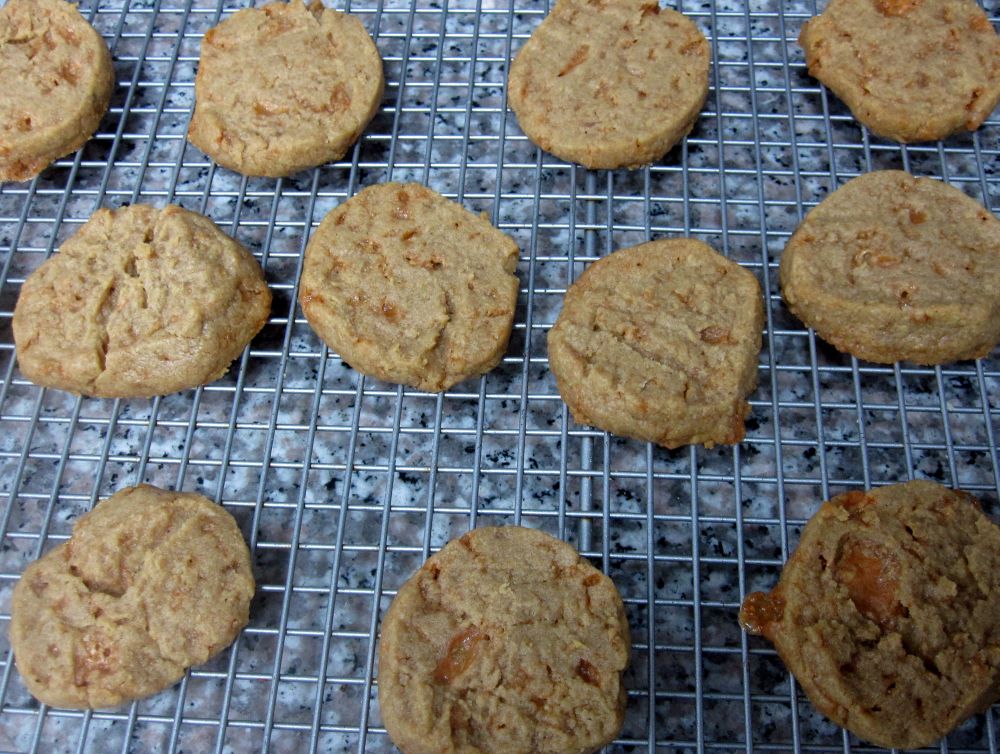
This time around, I took her crushed Butterfingers and decided to add them to a peanut butter cookie. And not just any peanut butter cookie. David Lebovitz's. I added some vanilla to his recipe, tossed the crushed Butterfingers in at the last minute, and shaped the dough into cookie logs so I could slice and bake. Oh man, these cookies are amazing. They are chewy and peanut buttery, and then they have these baked Butterfinger bits in them that add some caramelized crunch. I could not be happier with the result!


Peanut Butter Butterfinger Cookies
Adapted from a recipe by David Lebovitz in Ready for Dessert
Makes 30 cookies

1 1/4 cups all-purpose flour
1 tablespoon baking powder
1/4 teaspoon salt
1/2 cup (1 stick) unsalted butter, melted
1/2 cup granulated sugar
1/2 cup packed light brown sugar
1 cup creamy peanut butter (not natural; I used Skippy)
1 teaspoon vanilla extract
1 large egg, at room temperature
1 cup chopped Butterfingers (this is a rough estimate; feel free to use more or less!)

In a small bowl, whisk together the dry ingredients (flour, baking powder, and salt). Set aside.

In a stand mixer or large bowl with hand mixer, beat the butter, both sugars, and peanut butter together on medium speed until smooth. Blend in the vanilla and egg. Add the dry ingredients and mix just until incorporated. Stir in the chopped Butterfingers.

Leave in the bowl, covered, or shape the dough into a couple of logs wrapped in plastic wrap. Then chill in the fridge for at least 2 hours or overnight. You can also freeze the cookie dough logs in Ziploc bags to make cookies at a later date.

When you're ready to bake, preheat the oven to 350 degrees F. Line 2 baking sheets with silicone baking mats or parchment paper. Drop balls of dough onto the baking sheet or slicing the logs into approximately 1/2-inch thick discs and space evenly apart. Use a fork to flatten the tops of the cookies. Bake for 8 to 10 minutes, rotating the sheets front to back and top shelf to bottom shelf halfway through baking. The cookies will look slightly underdone, but start to look golden around the edges. Underdone is the key to chewy cookies!!

Cool the cookies on the baking sheets for 10 minutes, then transfer to cooling racks.


Step-by-Step in Pictures
Whisk together the dry ingredients and set aside...

In a large bowl, beat together the butter, sugars, and peanut butter...

Blend in the egg and vanilla...

Stir in the dry ingredients...

Stir in the Butterfinger bits...

Mix just until incorporated...

Shape into cookie dough logs and wrap in plastic wrap. Chill in the fridge for at least 2 hours, or freeze in a Ziploc bag...

If you're going to freeze to bake at a later time, be sure to include some instructions on the Ziploc bag so you'll know how to finish off the baking!

When you're ready to bake, slice the log into discs...

Place the discs evenly apart on a baking sheet, then press down with a fork to create a crosshatch design...

Bake at 350 degrees F for 8-10 minutes. Err on the side of underbaking them...

Yummo!!

Sunday, September 11, 2011

The Award for Coolest Eating Utensils Goes to...Bitten Silverware


A guy named Mark Reigelman, an artist, created this genius silverware. I'm not sure what it would feel like to hold these in your hands while eating - perhaps a bit (pun intended) sharp or uncomfortable? But worth it, right? Way to go, Mark. I am awarding you with the Happy Go Marni Award for Coolest Eating Utensils.


And now it's time to meet the man. This is Mark(s) Reigelman. In the Info section of his site, he dedicates a page to his Team. When you get there, this is what you see. A bunch of Marks. Ha!

Tuesday, September 6, 2011

Girl Scout Pie, er, Cookie Chart

Photo Credit: Celine Grouard

Just read this in Wired Magazine. According to Girl Scout Cookie sales data, here's how the cookie crumbles. Most popular cookie is Thin Mint, followed by Samoas. BUT! If you combine the Peanut Butter Sandwich and Peanut Butter Patties, peanut butter cookies are very well represented, in fact inching out Samoas. Go PB! I hope I've gotten you in the mood; it's almost Girl Scout Cookie Season. This concludes today's cookie report.

Sunday, September 4, 2011

Oreo Kit Kat Chocolate Chip Cookies


Chocolate chip cookies are the new kitchen sink cookie. Or maybe it's not new but I'm just late to discover this. You can pretty much take any chocolate chip cookie recipe and then toss in additional ingredients you have on hand. I can't vouch for the results each time, since what you add in might be extremely weird or even gross, but I can say it's a lot of fun to experiment, and a great way to get rid of leftover candy bits.


So recently I decided to take a traditional chocolate chip cookie recipe, and add in chopped Oreo cookies and Kit Kat pieces. An Oreo cookie in a chocolate chip cookie is very meta, very redundant, and that is a very good thing. The Kit Kat pieces add some crunch because of the wafer, and they remain intact after baking.

Put on your lab coat and experiment with chocolate chip cookie mix-ins!


Oreo Kit Kat Chocolate Chip Cookies
Adapted from a recipe in Southern Living Best Loved Cookies
Makes approximately 5 dozen cookies

3/4 cup (1 1/2 sticks) butter, softened
3/4 cup granulated sugar
3/4 cup firmly packed dark brown sugar
2 large eggs
1 1/2 teaspoons vanilla extract
2 1/4 cups plus 2 tablespoons all-purpose flour
1 teaspoon baking soda
3/4 teaspoon salt
1 (12-oz.) package semisweet chocolate chips
1 cup chopped or crushed Oreo cookies (the quantity here is flexible)
1 cup chopped Kit Kat bars (feel free to use slightly more or slightly less)

Using an electric mixer, beat together the butter and the sugars until creamy. Add the eggs, one at a time, then the vanilla.

Combine the dry ingredients (flour, baking soda, and salt) in a small bowl, then gradually add to the creamed butter mixture. Finally, stir in the chocolate chips, Oreo cookies, and Kit Kat bars.

Chill the dough in the fridge for an hour or shape into logs, wrap in plastic wrap, and freeze in plastic storage bags in the freezer for ready-to-go slice-and-bake cookies (just be sure to write the baking time and oven temperature on the bag as a reminder for later).

Drop tablespoonfuls of dough onto an ungreased cookie sheet, or slice 1/2-inch discs of dough from the thawed out dough logs that were in the freezer.

Bake at 350 degrees F for 7 to 12 minutes. I prefer soft, chewy, slightly underdone cookies so I bake on the shorter end of the time range. Remove the cookies from the oven and cool on cookie sheet for 10 minutes, then transfer to wire rack to cool completely.


Step-by-Step in Pictures
Beat the butter and sugars until creamy...

Add the eggs and vanilla and beat until incorporated...
Beat in the dry ingredients...

Stir in the chocolate chips, Oreo cookies, and Kit Kat bars...

Chill the dough in the fridge for an hour...
Or shape the dough into logs, wrap in plastic wrap, and freeze in bags until ready to use...
Place tablespoonfuls of dough evenly apart on a baking sheet...

Bake at 350 degrees F for 7 to 12 minutes, then allow to cool, and enjoy!

Friday, August 12, 2011

Dill Pickle Bread, Because Weird is Fun!


I think it took me all of 5 seconds to decide if I would make this bread. Usually there's a whole lot of deliberation before I decide what baking project I will take on. I'll sit with several cookbooks, mark them with post-it notes, and anywhere from an hour to 3 hours later, I've made my choice. None of that happened with this pickle bread. I basically read the title, read the pickle ingredients it called for (just to make sure it sounded pickly enough for my satisfaction), and made my way to the kitchen. It was that simple.


This bread truly tastes like pickles. And sure, that is a little weird but it is surprisingly good. The texture is an absolute 10. Soft and chewy. And it has a sour flavor similar to sourdough.

I will say, using a cup of pickle juice pretty much means there's no juice left in your jar of pickles. And the recipe only calls for one chopped pickle. So I guess that means you have to eat the rest of the pickles right then, or host a pickle party that afternoon so they don't go to waste. Or I guess you can save the pickles for later. But since you've used up the pickle juice, what liquid do you put back in the pickle jar so the pickles will last? If you are a pickle expert, please advise in the comments below!


My brilliant mom made the suggestion that this bread would be perfect for a corned beef sandwich. Or how about pastrami! Makes sense since you eat dill pickles at the same deli where you get your corned beef or pastrami sandwich. Why not in the same bite? Jewish delis, are you listening?


Dill Pickle Bread
Adapted from a recipe on What's Cooking America

1 generous cup lukewarm dill pickle juice
3 teaspoons instant active dry yeast
1 tablespoon granulated sugar
1 tablespoon extra-virgin olive oil
1 tablespoon dried dill weed
1/4 teaspoon salt
1 large dill pickle, finely chopped
3 cups bread flour or unbleached all-purpose flour

In a standmixer or large bowl, stir together the warm pickle juice, yeast, and sugar. Add in the oil, dill, salt, chopped pickle, and 1 cup of the flour. Beat until incorporated. Gradually add the remaining two cups of flour, adding an additional tablespoon of flour at a time until the dough forms a soft, elastic ball and pulls away from the sides of the bowl.

Knead the dough on a floured work surface. Place in an oiled bowl and turn once to coat. Cover the bowl and leave in a warm place to rise until doubled in size, about an hour.

Turn the dough out onto the floured work surface and shape the dough into a loaf by rolling or stretching it into a rectangle, then folding it in thirds like a letter, turning it over, and tucking the ends underneath.

Spray a 9x5-inch loaf pan with nonstick cooking spray, then sprinkle the bottom and partway up the sides with cornmeal. Place the shaped dough into the loaf pan and cover. Allow to rise in a warm place about 40 minutes.

Preheat the oven to 400 degrees F. Using a very sharp knife, make three diagonal slashes in the top of the dough. Brush the top with water. Bake for 25-35 minutes. If the bread starts to get dark brown but isn't done baking yet, cover the top with foil and return to the oven. To check for doneness, remove the loaf from the pan and tap the bottom with your finger. It should make a hollow sound. If it doesn't, return the loaf to the pan and return the pan to the oven to bake for a few more minutes.

When done baking, remove from the oven and allow to cool out of the pan on a wire rack.


Step-by-Step in Pictures
Combine the sugar, yeast, and pickle juice...

Chop up a pickle or two!

Add in the oil, dill, salt, chopped pickle and 1 cup of the flour...

Add in the remaining 2 cups of flour...
Mix and add a tablespoon at a time of flour until the dough pulls away from the sides of the bowl...

Knead the dough, then place in a greased bowl, cover, and let rise for about an hour...

When the dough is ready, it will have doubled in size...

Shape the dough into a rectangle...

Fold the dough in thirds like a letter going into an envelope...

Tuck the ends under and pinch to seal...

Place in a greased loaf pan that has been dusted with cornmeal, cover and let rise about 40 minutes...
Once risen, slash the top of the loaf three times, then brush the surface with water...
Bake at 400 degrees F for 25 to 35 minutes...

Let cool out of the pan...

Slice and serve with butter or use for a corned beef or pastrami sandwich!
Related Posts with Thumbnails